The information below presents the features described in our original lending materials in readable text. Provider terms, available protocols and asset support may change.
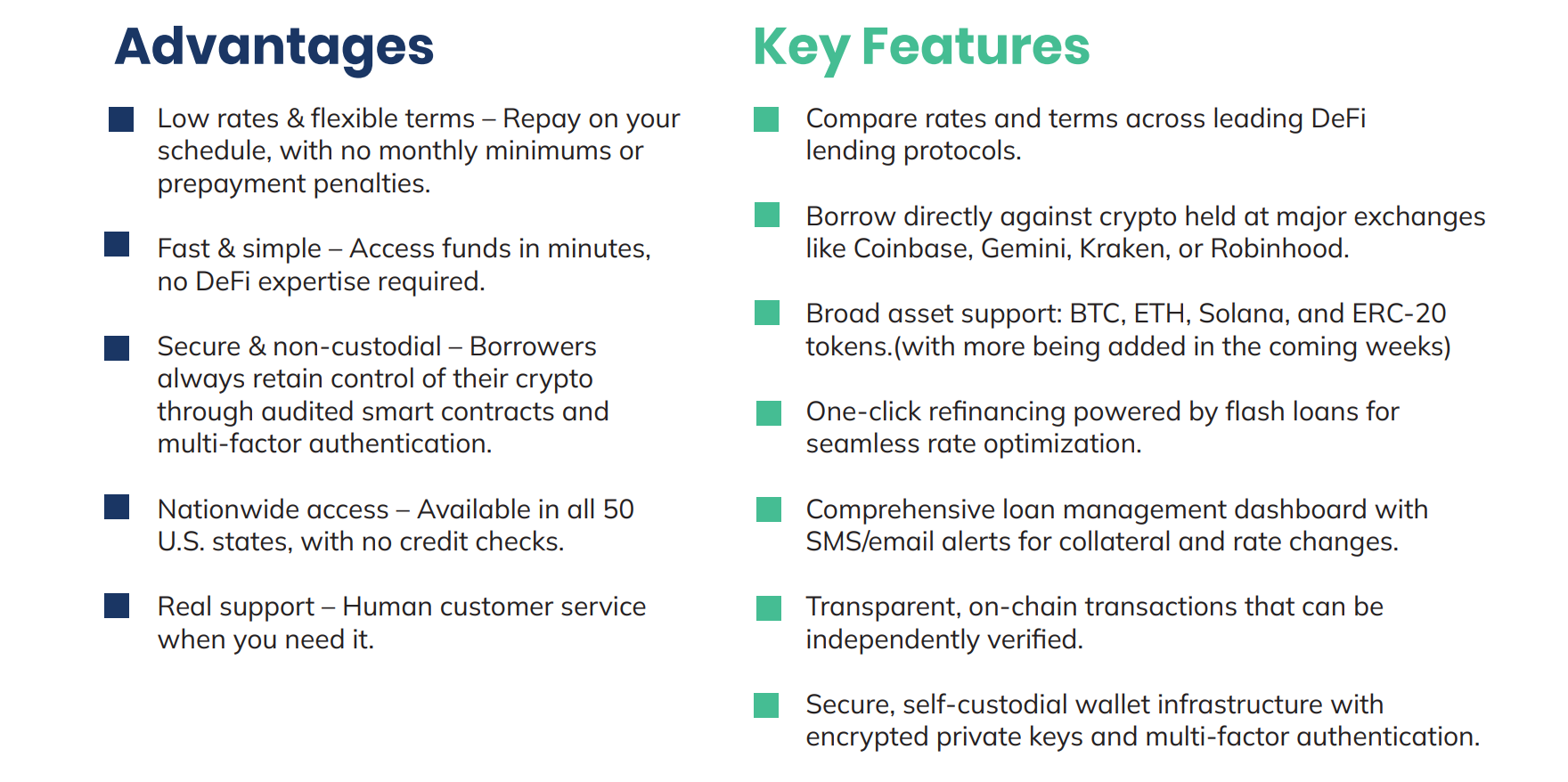
Advertised advantages
Flexible repayment scheduling, with no monthly minimums or prepayment penalties described in the original program.
Access to funds in minutes without requiring DeFi expertise.
Non-custodial lending through audited smart contracts and multi-factor authentication.
Availability across all 50 U.S. states without credit checks, as described in the original materials.
Human customer support when needed.
Key features
Compare rates and terms across decentralized finance (DeFi) lending protocols.
Borrow against crypto held on exchanges such as Coinbase, Gemini, Kraken or Robinhood, subject to provider support.
Support described for BTC, ETH, Solana and ERC-20 tokens.
One-click refinancing using flash loans to seek available rates.
Loan dashboard with SMS and email alerts for collateral and rate changes.
Transparent on-chain transactions that can be independently verified.
Self-custodial wallet infrastructure with encrypted private keys and multi-factor authentication.
Understand the risk
Loans are secured by cryptocurrency collateral. A fall in collateral value can trigger liquidation.
Floating interest rates and lending terms can change.
Monitor your loan-to-value ratio and respond to collateral alerts.
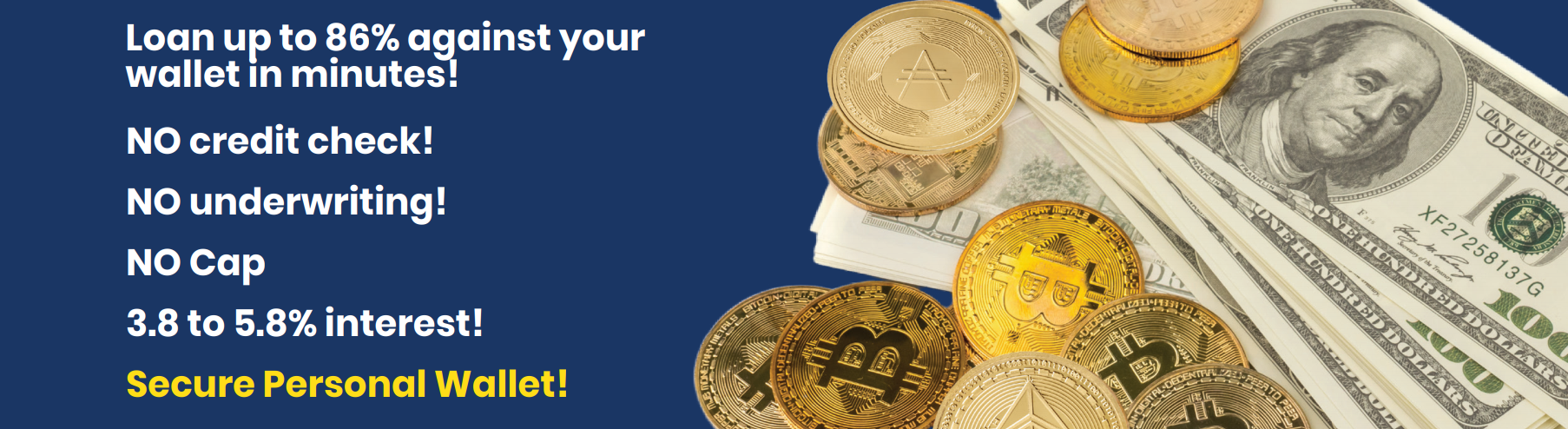
The original banner advertised up to 86% loan-to-value, 3.8–5.8% interest and no cap. These figures are historical marketing information, not guaranteed current terms.
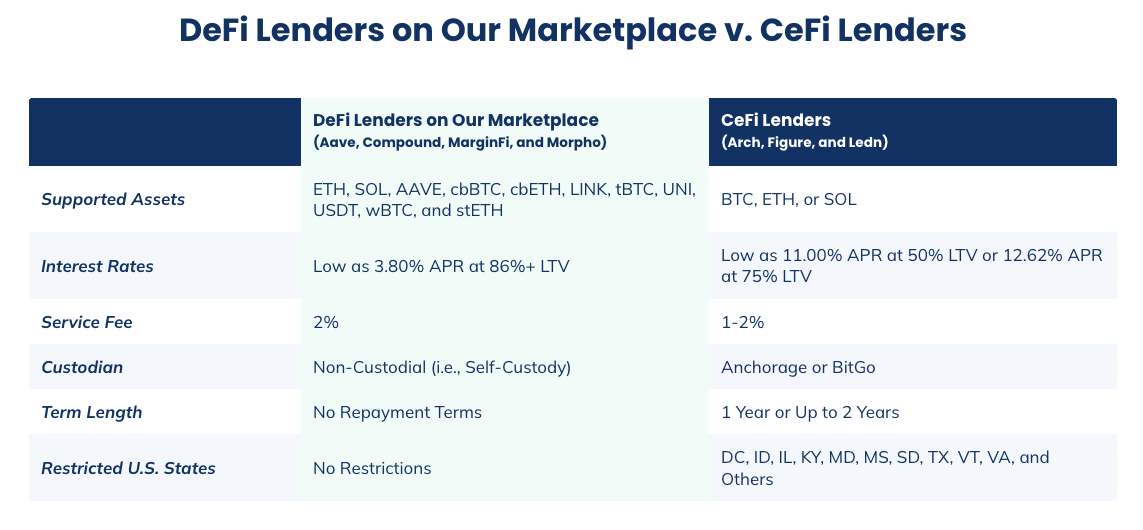
How the lending models compare.
Historical comparison from the original page. These figures are retained for reference; request a current provider quote.
As low as 11.00% APR at 50% LTV or 12.62% APR at 75% LTV
Service fee
2%
1–2%
Custodian
Non-custodial / self-custody
Anchorage or BitGo
Term length
No fixed repayment terms listed
One year or up to two years
Restricted U.S. states listed
No restrictions listed
DC, ID, IL, KY, MD, MS, SD, TX, VT, VA and others
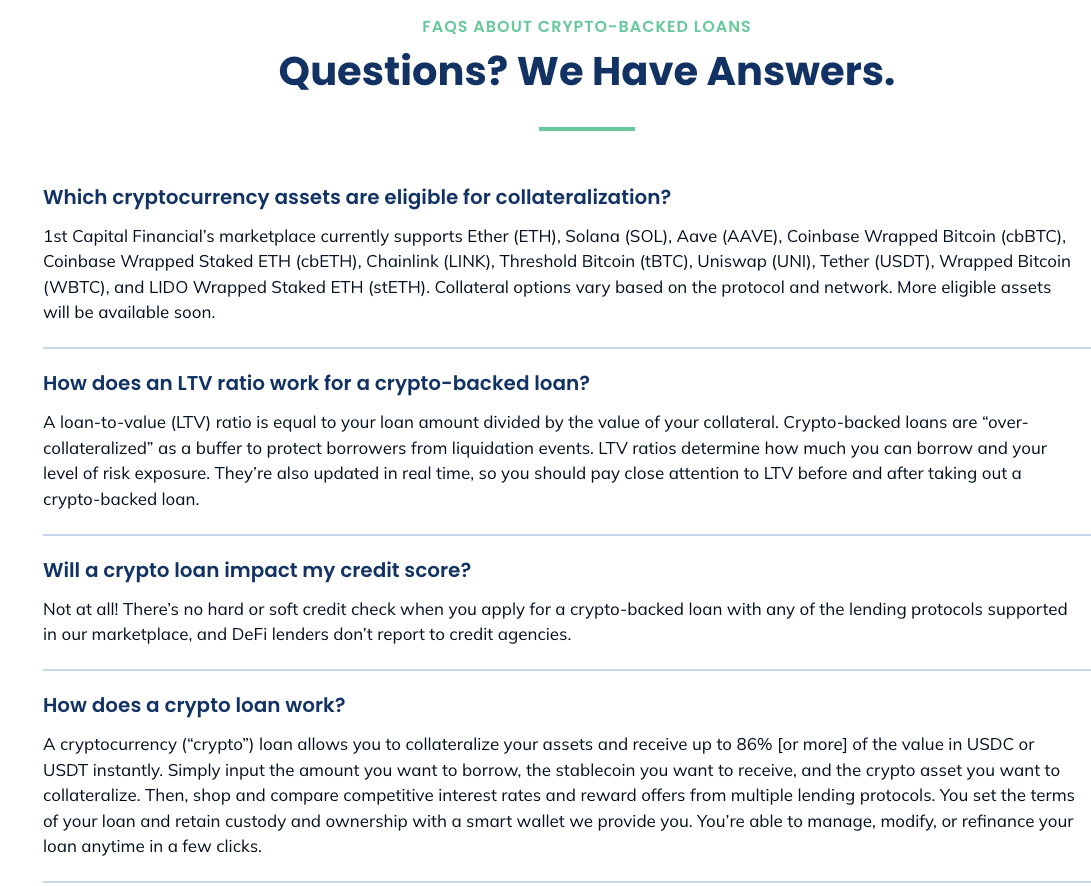
Your questions, answered.
Which cryptocurrencies are eligible as collateral?
The original 1st Capital Finance marketplace materials list Ether (ETH), Solana (SOL), Aave (AAVE), Coinbase Wrapped Bitcoin (cbBTC), Coinbase Wrapped Staked ETH (cbETH), Chainlink (LINK), Threshold Bitcoin (tBTC), Uniswap (UNI), Tether (USDT), Wrapped Bitcoin (WBTC) and LIDO Wrapped Staked ETH (stETH). Availability depends on the protocol and network; confirm current support with the provider.
What is a loan-to-value ratio?
Loan-to-value (LTV) is the loan amount divided by the value of your collateral. Crypto loans are overcollateralized to provide a buffer against price changes. Your LTV updates as prices move and determines borrowing capacity and liquidation risk.
Will a loan affect my credit score?
The original program states that participating DeFi lenders do not require a hard or soft credit check and do not report to credit agencies. Confirm the terms of the specific provider you choose.
How does a crypto loan work?
Choose the amount to borrow, the stablecoin you want to receive and the crypto asset to collateralize. Compare protocol rates and offers, then set up your loan through the provider’s wallet. The original materials describe borrowing up to 86% or more of collateral value in USDC or USDT, with options to manage, modify, refinance or repay. Actual limits depend on current terms.
Which protocols and networks are supported?
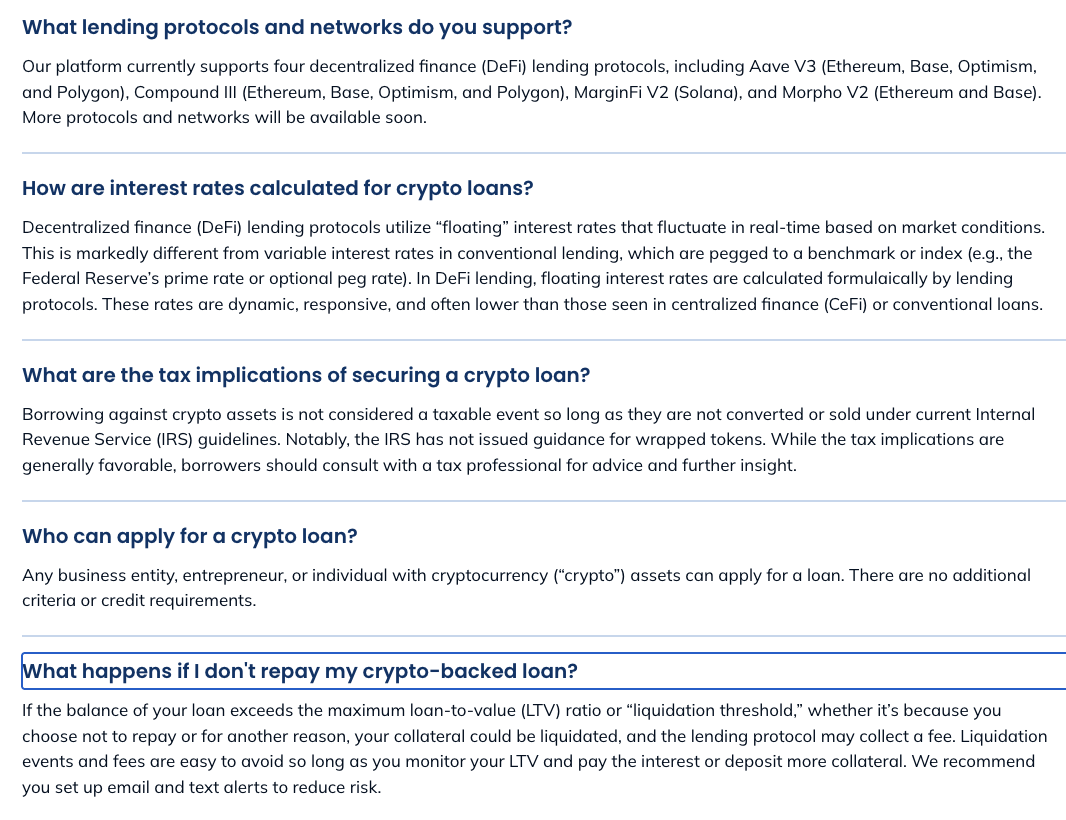
The original materials list Aave V3 on Ethereum, Base, Optimism and Polygon; Compound III on Ethereum, Base, Optimism and Polygon; MarginFi V2 on Solana; and Morpho V2 on Ethereum and Base. Confirm current integrations with the provider.
How is interest calculated?
DeFi lending commonly uses floating rates that change with market conditions. Rates are calculated by the lending protocol rather than fixed to a conventional loan benchmark. Your rate can increase or decrease during the loan.
What are the tax implications?
The original materials describe borrowing without selling the collateral. Tax treatment depends on the transaction and individual circumstances, and liquidation or conversion may have tax consequences. Consult a qualified tax professional.
Who can apply?
The original program is described as available to businesses, entrepreneurs and individuals holding supported crypto assets, without conventional credit criteria. Provider eligibility, network and legal restrictions may still apply.
What happens if the loan is not repaid or collateral loses value?
If your LTV reaches the protocol’s liquidation threshold, collateral may be liquidated and a fee may apply. Monitor your loan, pay interest or add collateral when needed, and use email and text alerts. Alerts do not eliminate liquidation risk.
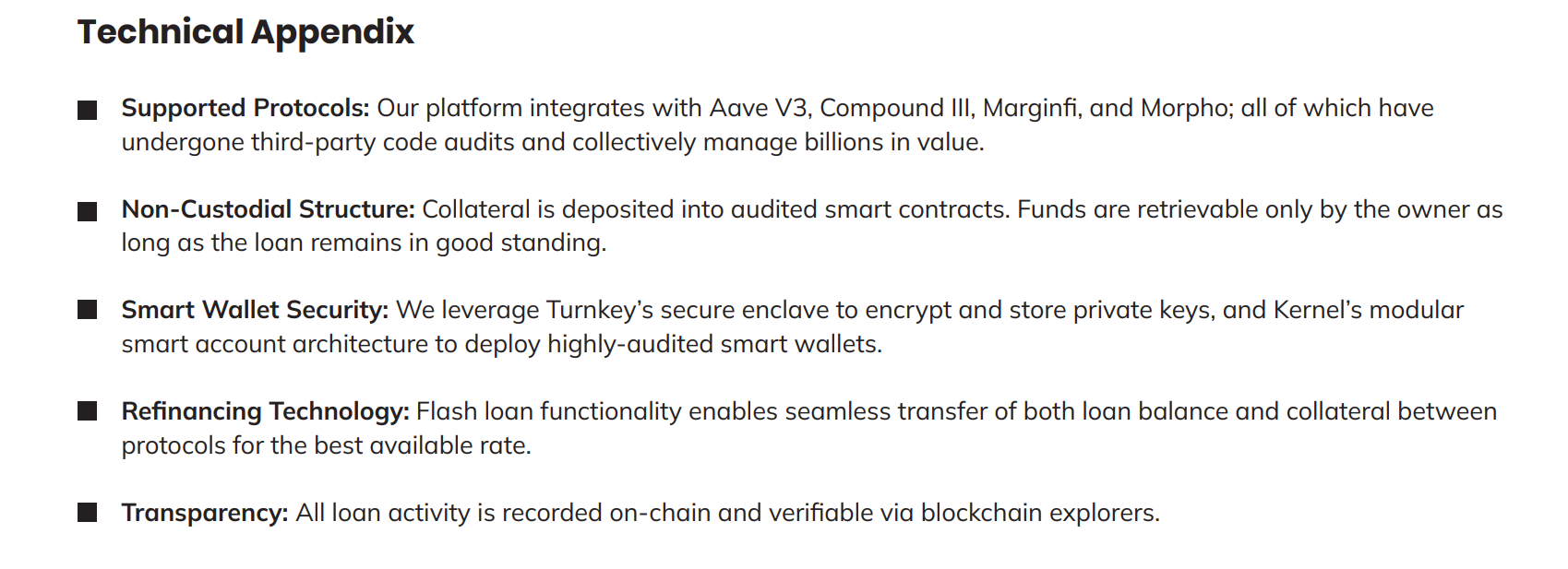
Technical details from the original program.
Supported protocols: Aave V3, Compound III, MarginFi and Morpho; described as having third-party code audits and collectively managing billions in value.
Non-custodial structure: collateral is deposited into audited smart contracts. Owner access to funds remains subject to the loan being in good standing.
Wallet security: the original materials describe Turnkey secure-enclave encryption and storage of private keys, with Kernel modular smart-account architecture.
Refinancing: flash-loan functionality is described as transferring both loan balances and collateral between protocols.
Transparency: loan activity is recorded on-chain and can be viewed using blockchain explorers.
Talk through your questions.
Contact Stoneleigh to arrange a short call about the lending program.
Our original page features Vegas Auto, described as a client offering crypto-backed loans to luxury-car buyers, and a Rocko article titled “How to Finance Your Car Purchase with Crypto Loan,” dated January 8, 2025, by Team Rocko, Co-Founder.
View the original lending graphics and car-financing feature